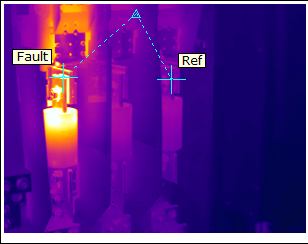
What Causes Electrical Hot Spots to Show Up in Equipment That Looks Fine?

Updated: Jun 19
One of the most common reactions to an infrared inspection report goes something like this:
“You found a hotspot caused by a loose wire in my electrical equipment? I just tightened that wire! And how did the screw come loose?”
Sometimes, an Infrared (IR) Thermography Electrical Safety Inspection report shows “hotspots” in equipment that appears to be working just fine.
However, even if a screw has been tightened perfectly, there are forces that work to loosen it over time, in very small increments, even despite regular maintenance. Screws in electrical equipment don’t just "fall out"; they are typically pushed loose, very slowly, by invisible physical forces until the tipping point. The imperceptible, incremental changes that result can eventually lead to equipment failure, or worse.
As a result, catching a hot spot early tends to be far cheaper than waiting for more obvious symptoms. Below, we examine the unseen risks accumulating in the background of industrial electrical equipment as well as the role of annual infrared inspections prescribed by NFPA 70B at least every 12 months.

Why Electrical Connections Loosen Over Time
A properly torqued electrical connection doesn't stay that way forever. Three mechanical forces work against it constantly, each one contributing to a process so gradual it's invisible to routine visual inspection.
Thermal Cycling: The Ratchet Effect
Every time current flows through a wire, the wire heats up; every time it stops, it cools down. Metals expand and contract with each cycle — and different metals do so at different rates. An aluminum conductor expands significantly more than a steel screw with each heating cycle.
This repeated expansion and contraction is sometimes called the breathing effect; imagine the equipment “inhaling” and “exhaling” with each load cycle as mechanical stress accumulates each time. The breathing effect starts the ratchet effect.
The heated wire expands and pushes hard against the screw. If it pushes too hard, it can permanently deform the conductor or microscopically stretch the screw.
When it cools, both materials contract, but that deformation means they don't return to exactly where they started. A microscopic gap opens. The connection is fractionally looser than before, and the process repeats with every startup, shutdown, and load change.
Creep: The Cold Flow of Metal Under Pressure
Softer conductive metals — copper and aluminum in particular — behave somewhat like very stiff clay. Under the constant clamping force of a tightened screw, the metal slowly flows away from the pressure point. This is called creep, or cold flow, and it happens at room temperature over months and years.
As the metal gradually thins under the screw head, the clamping tension that held the connection together slowly disappears. When the contact pressure drops, so does the quality of the electrical connection.
Aluminum conductors are especially susceptible to creep, and aluminum connections are disproportionately represented in hot spot findings.
Vibration: Micro-Slippage Over Time
In industrial environments near motors, transformers, compressors, HVAC equipment, and production machinery, electrical equipment is subject to constant low-level vibration. Each vibration cycle induces a tiny amount of micro-slippage between the screw and the conductor.
Over thousands or millions of cycles, these tiny constant vibrations can rotate a screw backward enough to reduce contact pressure. This happens especially if the initial spring tension has already been reduced by creep or thermal cycling.
How a Loose Connection Becomes a Hot Spot
Once the screw is loose through any combination of the three mechanisms above, the electrical consequences follow a predictable and self-reinforcing sequence known as the Thermal Runaway.
Increased Contact Resistance
A tight connection allows electricity to flow through thousands of microscopic contact points. A loose connection forces that same amount of electricity to squeeze through only a few tiny points of contact.
The Physics: This bottleneck increases electrical resistance. According to Joule’s Law (P = I2R), heat generation is proportional to resistance.
Result: The connection point becomes significantly hotter than the surrounding wire. This appears as a hot spot in an infrared inspection.
Oxidation: Resistance Compounding Resistance
Heat acts as a catalyst for chemical reactions. As the loose connection gets hot, it reacts with oxygen in the air to form oxides (like copper oxide or aluminum oxide) on the surface of the metal. Sometimes, this is visible in the form of rust, but more often you would not notice it with the naked eye.
Most metal oxides are electrical insulators (they don't conduct electricity well).
This oxide layer adds more resistance to the connection, which generates more heat, which creates more oxide.
This self-reinforcing cycle: resistance, heat, oxidation, more resistance is why hot spots that are not caught early tend to worsen rapidly rather than stabilize.
Arcing and the Risk of Fire
Eventually, the resistance becomes so high that the connection acts like a heating element.
Glowing: The metal can glow cherry-red.
Arcing: If the gap becomes wide enough, electricity may jump (arc) across it. Arcs are incredibly hot and can instantly melt the screw, the wire insulation, and the plastic housing, igniting a fire. Just to be clear: “arc” is not an “arc flash”. With arcing, the electricity is jumping a gap within the same conducting path and not to another phase or ground. An arc flash, on the other hand, is a release of energy between phases or to ground, a different and typically more violent event. Both are serious.
The progression from loose connection to fire can take months or years. Or it can happen quickly under high load conditions. Often, the damage is irreversible well before it starts glowing red – that’s why you need an infrared camera to detect it in time.
What NFPA 70B Says About Catching Hot Spots
NFPA 70B, the current standard for electrical equipment maintenance, prescribes annual (or more frequent) infrared inspections.
This correlates with the failure mechanisms described above: the sequence going from loose connection to hot spot to fire is predictable, not random. Infrared inspection interrupts that process, revealing what can still be fixed before it gets worse, well before arcing becomes a risk.
Prevention Via Regular IR Electrical Safety Inspections
A hot spot caught during an annual inspection is a maintenance task. A hot spot discovered after it has progressed to arcing or fire is an outage, a replacement, an investigation, and potentially a liability. The cost difference between the two scenarios is usually substantial.
Periodic infrared inspections as prescribed by NFPA 70B (which since 2023 mandates infrared scans at least every 12 months for most equipment) will catch hotspots before they cause downtime. Taking action after discovering a hotspot will allow you to schedule downtime instead of your equipment scheduling it for you.
Guidant Power, through its Monroe Infrared team, performs electrical infrared inspections for facilities of all types and sizes in accordance with NFPA 70B standards. Learn more about our electrical thermography inspection services — or explore how infrared inspection connects to a complete electrical safety program.