
Certified Thermographers
Professional-Grade IR Cameras
NFPA 70E Safe
BUILDING ENVELOPE IR INSPECTIONS
Your Building Is Losing Money Through Every Wall
Infrared (IR) thermography makes the invisible visible — revealing exactly where your building envelope is failing, where energy is escaping, and where moisture is infiltrating, all without opening a single wall.
Energy Loss
Moisture
Air Leakage
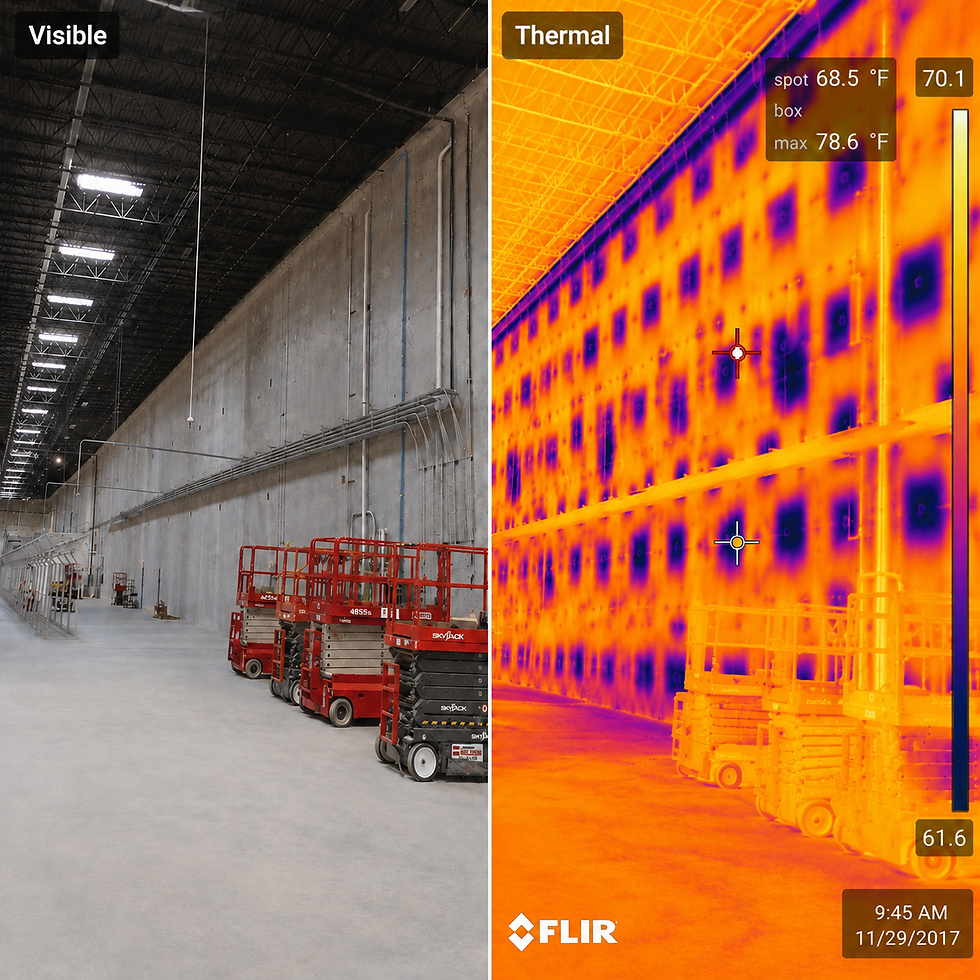
Big box retailer adding a cement block wall to their facility, supposed to be insulated with Styrofoam beads dumped into the hollow spaces of the blocks. The thermography shows the wall was not fully insulated, and the cold outside temperature, in contrast to the warmer, controlled indoor climate, clearly highlights the uninsulated voids. If not addressed on time, this will make the HVAC system work harder to condition the interior space for employees and customers.
~30%
Of facility operating cost is energy — the largest controllable expense
40+
Years performing building envelope IR inspections
$4–6
Return for every $1 invested in proactive inspections (OSHA est.)
Non-Destructive
No Wall Opening Required
LEED-Supportive Documentation
Commercial & Industrial Facilities
Available Nationwide

Wildfire ignition prevention
Main & sub electrical panels
Switchgear & switchboards
Transformers (dry & liquid-filled)
Motor control centers (MCCs)
Distribution boards & bus ducts
Utility service entrances

Vegetation is the #1 reliability threat
Main & sub electrical panels
Switchgear & switchboards
Transformers (dry & liquid-filled)
Motor control centers (MCCs)
Distribution boards & bus ducts
Utility service entrances

Hidden defects only show as heat or corona first
Main & sub electrical panels
Switchgear & switchboards
Transformers (dry & liquid-filled)
Motor control centers (MCCs)
Distribution boards & bus ducts
Utility service entrances

Speed and safety at scale
Main & sub electrical panels
Switchgear & switchboards
Transformers (dry & liquid-filled)
Motor control centers (MCCs)
Distribution boards & bus ducts
Utility service entrances
THE BUSINESS CASE
Energy Is Your Largest Controllable Cost — and Your Envelope Is Why
Nearly 30% of the cost to maintain and operate commercial and industrial facilities is attributable to energy — and a significant portion of that cost walks straight out through the building envelope every day. Gaps in insulation, failed sealants, degraded windows, and invisible air infiltration or exfiltration pathways collectively force HVAC systems to work harder and longer than they should.
Infrared thermography is the only proven non-destructive inspection method for identifying in real-time both energy loss and moisture intrusion simultaneously — without opening walls, removing cladding, or disrupting operations. A single inspection can reveal problems that have been silently inflating your utility bills for years.
The shift from “react and repair” to “predict and prevent” starts with knowing exactly where your envelope is performing as designed and expected and where it is failing. IR thermography gives facility managers, EHS professionals, and operations leaders the visibility they need to act before small defects become expensive remediation projects.
IR Is the Only Non-Destructive Method That Finds Both Problems at Once
Most diagnostic tools detect either energy loss or moisture — not both. Infrared thermography detects the thermal signatures of insulation defects, air movement, and moisture simultaneously in a single survey pass, making it uniquely efficient for whole-building envelope assessments.
What Trapped Moisture Does to a Roof
Inflated Energy Bills — Every Month
Insulation gaps, thermal bridges, and air leaks force heating and cooling systems to compensate continuously. These losses are silent, cumulative, and directly tied to operating cost.
Mold, Mildew, and IAQ Risk
Moisture infiltrating walls and insulation creates ideal conditions for mold and mildew, threatening indoor air quality, occupant health, and liability exposure.
Structural Deterioration Over Time
Persistent moisture causes corrosion in metal framing, rot in wood structures, and spalling in concrete — damage that compounds quietly until it becomes a major capital repair.
Occupant Comfort and Productivity
Cold walls, drafts from air infiltration, and humidity imbalances all degrade occupant comfort — affecting staff productivity and tenant satisfaction in commercial buildings.
Insurance and Compliance Exposure
Undetected moisture damage can complicate property insurance claims and create compliance issues under OSHA’s General Duty Clause, which requires workplaces free from recognized hazards.
THE PHYSICS
Three Ways IR Sees What Your Eyes Cannot
IR thermography works because abnormal heat patterns on a surface reflect/identify abnormal conditions beneath it. The camera only measures what is emitted from surfaces — it does not see through walls like X-ray vision. But those surface thermal patterns are remarkably informative when read by a trained thermographer.

Missing or Degraded Insulation
Where insulation is absent, poorly installed, or has settled over time, the wall or ceiling surface temperature deviates measurably from surrounding areas. In cold weather, these zones appear cooler on an interior scan. In hot weather, they appear warmer. Either way, the thermal pattern is clear and quantifiable.
Thermal Bridging

Air Infiltration & Exfiltration
Air leaks create distinctive wispy or streaking thermal patterns as conditioned air escapes or outside air infiltrates through gaps, penetrations, and failed seals around windows, doors, and utility entries. These patterns are especially clear when indoor and outdoor temperatures differ significantly — the greater the ΔT, the more visible the leak.
Air Leakage

Moisture Intrusion
Moisture in walls, insulation, and building materials alters their thermal behavior due to differences in heat capacity, evaporation, and conductivity. Wet materials cool differently than dry materials, creating temperature anomalies that are visible to a trained thermographer — revealing intrusion pathways long before staining or visible damage appears.
Moisture Detection
Thermography detects surface symptoms that point to deeper root causes
Because the camera reads surfaces, not interiors, a trained and certified thermographer is essential. The same surface temperature pattern can have multiple causes — an untrained operator will misdiagnose or miss findings entirely. All Guidant Power envelope inspections are performed by certified thermographers who know how to separate genuine anomalies from reflections, emissivity effects, HVAC influences, and other false signals.
WHAT IR REVEALS
A Complete Picture of Envelope Performance
Building envelope IR inspections are not limited to a single defect type. A single survey pass can surface multiple categories of problems across the entire building skin — providing facility managers with a prioritized remediation roadmap from one engagement.

Insulation Defects
Missing, settled, compressed, or improperly installed insulation in walls, ceilings, and floors. Includes thermal bridging through structural framing members and cold spots at penetration points.

Air Infiltration & Exfiltration
Gaps and failures around windows, doors, utility penetrations, electrical boxes, and curtain wall systems. Air leakage is often the most significant and most correctable source of energy loss in commercial buildings.

Moisture Intrusion
Water infiltrating behind cladding, within wall cavities, above ceilings, and around window and door assemblies — before staining, mold, or visible damage appears. Includes detection of plumbing leaks within walls.

Window & Door Failures
Failed seals in insulated glazing units (IGU), thermal bridging in window frames, inadequate perimeter sealing, and air leakage at thresholds and weatherstripping — all clearly visible in the thermal image.

Penetration & Utility Gaps
Conduit, pipe, and duct penetrations through the building envelope that lack proper sealing or backing insulation. Among the most common and most overlooked sources of both air leakage and moisture infiltration in commercial buildings.

EIFS & Facade Delamination
Delamination of Exterior Insulation and Finish Systems (EIFS) and other cladding systems creates distinctive thermal patterns as separated areas heat and cool differently from bonded sections. Detectable before visible cracking or water intrusion occurs.
MONITOR
Stage
Repair can be made during normal preventive maintenance (PM) service.
What’s Happening
Water enters through a small defect; moisture begins infiltrating insulation in a localized area
Consequence
Minor insulation saturation, no visible interior symptoms yet
REPAIR SOON
Stage
Spreading — Insulation Saturation
What’s Happening
Moisture migrates laterally through the insulation, expanding beyond the original entry point
Consequence
R-value loss increasing energy costs; insulation structurally weakening
REPAIR NOW
Stage
Structural — Deck Exposure
What’s Happening
Moisture reaches the structural deck; metal decking rusts, concrete absorbs water, wood rots
Consequence
Structural integrity compromised; repair scope and costs escalate significantly
CRITICAL
Stage
Interior — Ceiling & Wall Damage
What’s Happening
Water breaches the deck; affects interior ceilings, walls, insulation, and building contents
Consequence
Visible staining, mold risk, damage to assets, occupant disruption
EMERGENCY
Stage
Full Failure — Replacement Required
What’s Happening
Moisture damage too widespread for targeted repairs; full tearoff and replacement is the only option
Consequence
$8–$10+ per sq ft in replacement costs; significant business disruption
SURVEY REQUIREMENTS
Getting the Conditions Right
Unlike electrical inspections, which are performed under load at any time of year, building envelope surveys require specific environmental conditions to produce reliable results. The fundamental requirement is a meaningful temperature differential between the inside and outside of the building — typically at least 15–18°F — so that heat flow through the envelope is strong enough to be measured.
This makes heating season (winter) and cooling season (summer) the primary survey windows for most of North America. In practice, heating season surveys are generally preferred because the ΔT tends to be larger, more consistent, and more controllable.
Environmental factors — wind, solar loading, rainfall, and HVAC operation — all affect what the camera sees. Our thermographers assess site and weather conditions before every inspection and advise on the optimal timing window for your facility’s location and survey objectives.
Interior vs. Exterior Scanning
Both approaches are valid and often complementary. Interior scans are more common because air movement rarely travels in a straight line through a wall — the thermal signature of a leak often appears some distance from the actual gap. Exterior scans are useful for large-scale façade assessment and for spotting moisture in cladding systems. Our team recommends the appropriate method — or combination — for your specific building type and objectives.
CRITICAL
Condition
ΔT (Interior–Exterior)
Requirement
15–18°F minimum; 25°F+ preferred for best resolution
IDEAL
Condition
Heating Season
Requirement
Cold exterior, warm interior — strong inward heat flow makes defects highly visible
MODERATE
Condition
Wind Conditions
Requirement
Light wind acceptable; high winds can suppress air infiltration signatures
GOOD
Condition
Cooling Season
Requirement
Hot exterior, cooled interior — effective but ΔT may be less consistent
TIMING MATTERS
Condition
Solar Loading
Requirement
Scan best performed at night or early morning to avoid solar reflection masking wall patterns
AVOID
Condition
Rain / Wet Surfaces
Requirement
Evaporative cooling from wet surfaces creates false anomalies — surfaces must be dry
REQUIRED
Condition
HVAC Status
Requirement
System must be operating normally for at least 4 hours prior to scanning to stabilize thermal patterns
WHEN TO INSPECT
The Right Inspection for Every Stage of a Building’s Life
Building envelope IR inspections deliver value at every point in a building’s lifecycle — from new construction verification to existing facility optimization to pre-transaction due diligence.

New Construction Commissioning
Infrared inspection during or immediately after construction is one of the highest-value applications of building envelope thermography. Insulation defects and air barrier failures discovered before drywall or cladding is installed can be corrected at minimal cost — the same defects found after occupancy require invasive, expensive remediation.
Highest ROI Application

Pre-Purchase Due Diligence
A building that looks sound may be concealing significant insulation failures and moisture damage within its walls. An IR envelope survey before closing provides objective data on the actual thermal performance and moisture condition of the building — informing price negotiation and repair escrow requirements.
Transaction Due Diligence

Energy Reduction Programs
When a facility manager knows energy is being wasted but cannot pinpoint where, IR thermography provides the evidence needed to prioritize and justify retrofit investments. The inspection pays for itself many times over when the findings guide targeted weatherization, insulation upgrades, and air sealing work.
Predictive Cost-Savings

Annual Envelope Monitoring
Envelopes degrade over time as sealants age, insulation settles, and cladding systems develop movement cracks. Annual or biennial IR surveys establish a thermal baseline for each section of the building, enabling maintenance teams to track deterioration, prioritize capital repairs, and catch moisture intrusion before it reaches structural components.
Trending & Baseline

LEED & Sustainability Certification
Building envelope IR inspection results support documentation requirements for LEED certification and other green building programs. Thermal imaging evidence of air barrier continuity, insulation installation quality, and envelope performance can contribute to multiple LEED credit categories.
LEED Documentation

Forensic & Legal Investigations
When construction defect litigation, insurance claims, or warranty disputes involve building envelope performance, IR thermography provides objective, photographic evidence of defect location, extent, and pattern. Our reports are prepared to defensible professional standards and have been used successfully in legal proceedings.
Defensible Evidence

WHO WE SERVE
The Right Inspection for Every Stage of a Building’s Life
Building envelope IR inspections deliver value at every point in a building’s lifecycle — from new construction verification to existing facility optimization to pre-transaction due diligence.
Prevent Unplanned Downtime & Cost Surprises
IR inspections support capital planning with accurate, prioritized findings rather than guesswork, and help avoid emergency repairs.
Facility Management
Eliminate Hidden Hazards Before They Escalate
Moisture intrusion, mold, and degraded insulation create recognized hazards. IR helps satisfy OSHA’s General Duty Clause and document proactive due diligence.
EHS Professionals
Reduce Energy Costs and Protect Productivity
Drafts, humidity imbalances, and cold walls affect occupant comfort. Results justify HVAC optimization and targeted weatherization investments.
Operations Leaders
Protect Asset Value Through Every Transaction
Envelope IR surveys support acquisition due diligence, capital reserve planning, and defensible evidence of building condition at time of sale or lease.
Property & Asset Management
Quantify and Reduce Your Carbon Footprint
IR inspections give sustainability teams specific, quantifiable data needed to prioritize envelope improvements as part of ESG and LEED programs.
Sustainability Teams
Verify Quality Before It Is Covered Up
IR thermography verifies insulation installation, air barrier continuity, and window sealing during construction — when corrections are fast and inexpensive.
Construction & Commissioning
Severity Classifications
CRITICAL
Action
Immediate action is required (Notify management and de-energize if necessary)
Typical Examples
Severely overloaded circuits; heavy oxidation; imminent failure signatures; internal arcing; clear life/safety hazards.
SERIOUS
Action
Repair/Replacement as soon as possible (monitor closely until resolved)
Typical Examples
High-resistance terminations with higher Delta T’s; failing fuses; moderate imbalanced loads; deteriorating insulation or visible component degradation.
INTERMEDIATE
Action
Repair should be made within a reasonable time (30-60 days)
Typical Examples
High-resistance terminations; moderate thermal signatures or load imbalances indicating early-stage fatigue.
MINOR
Action
Repair can be made during normal preventive maintenance (PM) service.
Typical Examples
Slight temperature differentials (<10°C rise); minor load imbalances under normal operating load.
DELIVERABLES
What’s Included in Your Building Envelope IR Report
An IR inspection is only as useful as the report it produces. Our reports are structured for decision-making — giving building owners, facility managers, contractors, and attorneys the documentation they need to act with confidence.
For Each Finding Identified
-
Thermal image and corresponding visible-light photograph of each anomaly
-
Precise building location — wall elevation, floor level, grid coordinate
-
Defect classification: insulation, air leakage, moisture, or structural — severity rated Critical, Serious, Intermediate, or Minor
-
Temperature differential (ΔT) data and severity rating
-
Root cause assessment and recommended corrective action
-
Severity classification (Critical / Serious / Intermediate / Minor) with repair priority and capital budgeting guidance
Full Inspection Report Package
-
Executive summary of overall envelope condition with findings by zone
-
Site conditions log: ambient temperatures, ΔT at time of scan, weather, HVAC status
-
Annotated building elevation drawings mapping all anomaly locations to scale
-
Thermographer certification, methodology statement, and equipment records
-
Energy impact commentary where findings are quantifiable
-
LEED-supportive documentation formatted for submission where applicable
WHY GUIDANT POWER
40+ Years of Infrared Experience. Every Application. One Partner.
Monroe Infrared — now a Guidant Power company — has been performing building envelope infrared inspections for over four decades. When it comes to building thermography, context, training, and experience are what separate a useful inspection from a collection of thermal images that no one acts on.

Certified Thermographers Only
Every building envelope inspection is performed by professionally certified thermographers who understand emissivity, environmental effects, HVAC influences, and the difference between a real anomaly and a false signal. Camera ownership is not a qualification — training is. Our thermographers are among the most qualified in the industry.

Context, Not Just Color
Thermal images don’t interpret themselves. A trained thermographer evaluates heat patterns in the context of building construction, materials, site conditions, and load conditions — not by color alone. The same surface temperature can mean very different things depending on what is behind it and what conditions produced it.

Professional-Grade Equipment
We use high-resolution, calibrated thermal imaging cameras with the sensitivity required to detect subtle temperature differentials in building assemblies. Consumer-grade cameras routinely miss anomalies that professional equipment captures clearly — the camera matters as much as the operator.
Reports Built for Action
Our reports go beyond thermal images — they include annotated building elevations, precise anomaly locations, severity classifications, root cause assessments, and prioritized corrective action guidance. They are formatted to support maintenance planning, capital budgeting, contractor direction, and legal proceedings.

Connected to a Full Safety Program
Guidant Power is not only a thermography company. We connect building envelope findings to our broader electrical safety, arc flash, and reliability programs — giving multi-site operators a single, consistent partner for all their infrared and safety inspection needs within our network.

Nationwide Coverage
We serve building owners, facility managers, property managers, general contractors, and commissioning agents across 47 states — from single-building assessments to multi-site portfolio programs for national operators. Not just large corporate clients — we work with organizations of every size.
FAQS
Frequently Asked Questions
Everything you need to know about building envelope infrared inspections — from how they work to what conditions are required and what the report delivers.