

AERIAL INSPECTIONS SERVICES
Visual and Thermal Aerial Inspection For Overhead Power Lines.
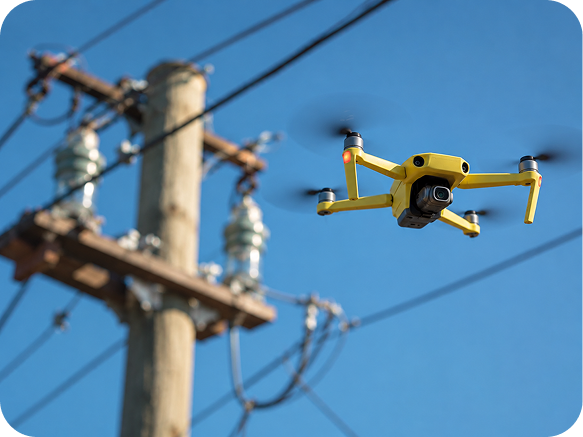
Guidant Power delivers close visual inspection and thermal scanning of overhead transmission and distribution lines so you can find and fix defects before they become outages, ignitions, or structural failures.
$121B
Annual cost of US outages (2024)
#1
Cause of outages: vegetation
2-in-1
Visual + thermal in one program
AERIAL INSPECTIONS SERVICES

Visual and Thermal Aerial Inspection For Overhead Power Lines.
Guidant Power delivers close visual inspection and thermal scanning of overhead transmission and distribution lines so you can find and fix defects before they become outages, ignitions, or structural failures.
$121B
Annual cost of US outages (2024)
#1
Cause of outages: vegetation
2-in-1
Visual + thermal in one program

KEY FACT: The financial stakes are real
Oak Ridge National Laboratory reported in March 2026 that the average yearly cost of major outages exceeded $67 billion over the previous seven years — reaching $121 billion in 2024. Inspections aren't a discretionary aviation program. They're a reliability, safety, wildfire, and asset-management investment.
WHY IT MATTERS
The Cost of Missing a Defect Isn't "maintenance later."
Across utility, regulatory, and research sources, the recurring message is the same: small, fixable conditions escalate into outages, wildfires, and structural failures when they go undetected. Aerial inspection is how you find them while they're still small.

Wildfire ignition prevention
Utilities in wildfire-prone territories now treat enhanced aerial inspection as an ignition-prevention activity — not just maintenance. California regulatory filings describe conductor, splice, infrared, and corona inspection as direct measures to help prevent future ignitions.

Vegetation is the #1 reliability threat
NERC's transmission vegetation standard confirms that major outages have resulted from interference between overgrown vegetation and transmission lines. DOE resilience guidance identifies vegetation-related impacts as the most common cause of power outages nationwide.

Hidden defects only show as heat or corona first
Some of the most serious failure precursors — worn splices, deteriorating connections, insulation stress — produce no visible defect before failure. Thermal and Acoustic Corona inspection catches these anomalies while they're still correctable, not after the conductor drops.

Speed and safety at scale
Drones inspect large transmission and distribution networks faster, capture close detail on inaccessible assets, and eliminate the need to put people on structures or in difficult terrain. More network covered, less exposure, better data.
INSPECTION METHODS
Two Methods. One Complete Picture.
Close visual inspection and thermal scanning are complementary, not competing tools. Visual finds the physical symptom. Thermal finds the energized symptom. Together, they cover the full spectrum of defects that matter most.
Close Visual Inspection
Drones — direct observation of physical condition

-
Broken or cracked insulators and contamination
-
Conductor corrosion, broken strands, fretting near clamps
-
Loose cotter pins, damaged clamps, missing hardware
-
Pole and tower structural distress or damage
-
Vegetation encroachment and right-of-way issues
-
Sag and clearance deficiencies to ground or structures
-
Post-storm damage assessment — structures and conductors
-
Corona and sparking indicators on high-voltage circuits
Best at: Physical defects and condition changes visible on the asset surface
Thermal Scanning
Infrared — detects heat signatures invisible to the naked eye

-
Hot splices and deteriorating connector joints
-
Hot dead-ends and jumper attachment points
-
Abnormal phase temperature differences under load
-
Energized anomalies with no visible surface defect
-
Heat buildup at insulators indicating leakage or stress
-
Internal deterioration showing only as temperature deviation
-
High-resistance connections worsening under load cycling
-
Worn splices approaching thermal failure threshold
Best at: Failure precursors that generate heat before they generate a visible defect
ALIGNED WITH
NERC FAC-003
NERC TPL Standards
CPUC Wildfire Mitigation
DOE Resilience Guidelines
FAA Part 107
RISK CATEGORIES
What We Find — and What It Prevents
Every defect category has a known progression path. Aerial inspection intercepts that path early — while repair is still straightforward. Here is what can be detected, why it matters, and what the consequence is if it goes undetected.
Risk Category
Hidden internal deterioration
What We Can Detect
Hot spots from internal deterioration, energized anomalies without visible surface defect
Why It Matters
Some failures only show up as temperature anomalies before visible damage appears
Consequence If Missed
Sudden failure, preventable ignition or outage
Risk Category
Storm & disaster damage
What We Can Detect
Downed structures, post-event conductor or structure damage
Why It Matters
Rapid damage assessment speeds restoration and triage
Consequence If Missed
Longer outages, slower restoration, higher customer impact
Risk Category
Corona & discharge activity
What We Can Detect
UV corona signatures, arcing indicators, sparking locations
Why It Matters
Indicates insulation or hardware stress, especially on higher-voltage circuits
Consequence If Missed
Progressive degradation, faulting, failure under stress
Risk Category
Sag & clearance issues
What We Can Detect
Line sagging, clearance deficiencies to ground, structures, or vegetation
Why It Matters
Reduced clearance increases the chance of arcing or contact
Consequence If Missed
Outage, fire, safety incident, clearance violation
Risk Category
Vegetation encroachment
What We Can Detect
Trees and brush approaching conductors, fall-in hazards, right-of-way issues
Why It Matters
Vegetation contact is a major reliability and wildfire driver
Consequence If Missed
Sustained outages, regulatory noncompliance, fire risk
Risk Category
Pole & tower distress
What We Can Detect
Structural damage, corrosion, member distress, pole condition issues
Why It Matters
Structural weaknesses stay hidden until wind or load events expose them
Consequence If Missed
Structure failure, cascading damage, public safety event
Risk Category
Hardware looseness or damage
What We Can Detect
Loose cotter pins, missing hardware, damaged clamps, physical displacement
Why It Matters
Small hardware defects progress into conductor movement or detachment
Consequence If Missed
Forced outage, line failure, emergency response cost
Risk Category
Insulator damage or contamination
What We Can Detect
Broken or cracked insulators, contamination, heat at insulators, corona activity
Why It Matters
Insulation failure leads to leakage, flashover, and faulting
Consequence If Missed
Trips, outages, ignition, equipment damage
Risk Category
Conductor damage
What We Can Detect
Broken strands, corrosion, cracks, fretting near clamps, loss of galvanizing
Why It Matters
Loss of cross-section and mechanical integrity reduces safety margin
Consequence If Missed
Line drop, wildfire ignition, emergency repair
Risk Category
Splice & connector deterioration
What We Can Detect
Hot splices, hot dead-ends, hot jumpers, worn splices, abnormal phase temperature differences
Why It Matters
High-resistance connections worsen under load and weather cycling
Consequence If Missed
Outage, conductor burn-down, ignition risk
OUR PROCESS
Give Us Your Line Files and Leave the Rest to Us
Upload your portfolio and our experts will design a customized data collection schedule optimized for speed, coverage, and cost efficiency.

Receive Line Files
We securely import your vector line files (CAD, DXF, Shapefile, or equivalent) and prepare clean, structured data ready for mapping, analysis, and integration into your workflows.

Fly Lines, Collect Data
Our crews fly predefined flight paths to systematically capture high-resolution imagery and sensor data, providing full 360-degree asset coverage and consistent quality across the entire span.

Deliver Critical Defects in Real-Time
High-severity issues are identified, logged, and communicated to your operations team the same day they are found. No waiting for the final report.

Analyze Findings with ADEPT
Your team gets secure, interactive access to all collected data through ADEPT, our proprietary platform — built for visualization, quality review, and defect relationship analysis.

Deliver Report
A detailed report outlining all major and minor findings, structured to support data-driven maintenance prioritization and budget planning.
OUR TECHNOLOGY
About Our Proprietary ADEPT Software
ADEPT combines the best of three things: high-resolution imagery captured by skilled field crews, advanced machine learning that improves defect detection over time, and seasoned journeyman inspectors who precisely identify and quantify every issue found.
All findings are consolidated into a secure, easy-to-review report format, with built-in efficiency tools designed to make maintenance planning easier.

FAQS
Frequently Asked Questions
Everything you need to know about electrical infrared inspections, compliance, and what to expect when you work with Guidant Power.