
How to Build an Electrical Safety Program: A Seven-Step Guide for Facility Managers

Updated: Jun 8
Most facilities treat electrical safety like a checklist. Get the study. Do the training. Check the box.
On paper, it looks like everything has been covered. But in reality, there are gaps between the checkboxes. Equipment changes go unrecorded. Training becomes superficial. Workers rely on labels that no longer match what’s behind the panel door.
And just like that, risk goes up.
This is not about “dropping the ball” or assigning blame. It’s what happens when you can’t see the bigger picture hiding behind the checklist items.

With over 25 years leading industrial technology companies, I've observed this issue across industries and facility sizes. The organizations that “get it” share a common trait: they understand electrical safety for what it is: one interconnected system, not just a collection of individual line items. With each element reinforcing the next, these facilities are known for running well, protecting their people, and doing things the right way.
Outlined below is a seven-step process to build a stronger, interconnected electrical safety program.
Step 1: Establish Your Baseline
Arc flash analysis: know what you're actually dealing with
Most leaders think they understand the risk. Many don’t.
OSHA’s General Duty Clause and NFPA 70E create a clear expectation that arc flash hazards are identified and managed. Facilities that haven't conducted an analysis to identify arc flash hazards are exposed to OSHA citations and, more importantly, to the very real possibility that their workers face real and present danger they can’t see.
A complete evaluation of your entire electrical distribution system

An arc flash analysis is an engineering study that calculates fault currents, evaluates protective device coordination, determines incident energy levels, and produces labels that tell your workers what PPE is required before they work on electrical equipment.
It also delivers the most current one-line diagram of your electrical system, which is the map your maintenance and engineering teams depend on to locate, understand, and resolve everyday issues.
Why the five-year interval for arc flash analysis
NFPA 70E and OSHA both call for an arc flash study every 5 years, or sooner if the electrical system has been modified.
Electrical systems change over time. Equipment is added. Settings are adjusted. Loads shift. Each change impacts the risk in the panels. The labels may no longer be accurate, and that can put your employees at risk.
Guidant's field teams routinely find dangerous shortcuts, typically made to get production running, and are then forgotten. Some examples include copper pipes in fuse holders or unprogrammed main breakers. That is why it is required to inspect the equipment in full every five years, and not just rely on the statement “nothing has changed.”
An arc flash study answers a simple question: Do your labels match reality?
It's the foundation on which every other safety decision rests, from PPE selection to approach boundaries and safe work procedures.
Step 2: Monitor What Changes Between Studies.
Infrared inspections: your year-round warning system
Between arc flash studies, your equipment doesn't pause. Unseen forces loosen connections, degrade components, and shift load patterns as production demands change. These are conditions that generate heat, which is the precursor to failure.
Mechanical problems usually give you warning. You hear them. You feel them.
Electrical problems do not. Equipment can operate normally one moment and fail catastrophically the next, with no audible or visible warning in between.

Infrared inspections reveal hidden issues
Certified thermographers like those at Guidant use years of training and experience, combined with professional-grade thermal imaging, to identify overheating components, loose connections, overloaded circuits, failing breakers, and degraded terminations while there is time to fix them.
When an electrical component does fail unexpectedly, the replacement part is rarely what costs you. Lost production, emergency labor, collateral damage, and injury are the costs that escalate quickly.
For your organization's reputation, an electrical fire or arc flash incident carries consequences that extend well beyond the repair invoice.
The compliance landscape has changed
NFPA 70B's 2023 update moved infrared inspections from recommended to expected, with intervals of 12 months or less -- and more frequent scanning for critical equipment. This reflects a growing recognition across the industry that annual thermographic inspection is fundamental to responsible electrical equipment maintenance.
Where steps 1 and 2 connect
A well-run infrared program does more than catch developing faults. It documents equipment changes as they happen throughout the year, including new installations, replaced components, modified settings, and load changes, so that when your next arc flash study comes due, the data is already current. This typically means fewer surprises and reduced scope and cost.
Step 3: Build Internal Vigilance Between Inspections
Infrared cameras and training for your maintenance team
Infrared cameras have never been more affordable or easier to buy. And a maintenance team trained to use them well adds another layer of detection between formal inspections — spotting developing problems early and feeding updated information into both the maintenance workflow and arc flash documentation.
However, there is a difference between using a camera for troubleshooting and performing a full inspection program. One requires solid fundamentals. The other requires years of practice and judgment.
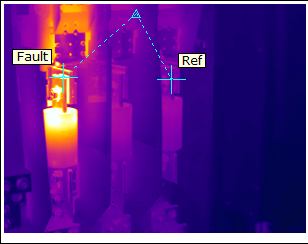
Both have real value, and they serve different purposes.
A well-structured infrared training program teaches the physics that drive thermal behavior, the methods for capturing accurate data, and the analytical skills to interpret findings correctly. It turns a thermal camera from an expensive flashlight into a genuine diagnostic tool.
Step 4: Train Everyone Who Works Near Electrical Equipment
Electrical safety training: five levels, one standard
Here's the gap that most programs miss: arc flash labels are only as effective as the workers who read them.

Does every person who opens an equipment panel understand what the label is telling them — how far to stand, what PPE to wear, when to stop and call someone?
If not, the engineering work behind that label doesn't translate into safe behavior. It sits on a sticker on a door.
OSHA is clear on this. Under 1910.332, anyone exposed to electrical hazards must be trained. And only qualified electrical workers are allowed to perform work on or near energized equipment. “Qualified” does not mean experienced. It means being trained to recognize the hazard and know how to avoid it.
Electrical incidents don’t only happen to electricians.
A janitor resets a breaker after hours.
A machine operator works near an open panel.
A contractor opens the wrong disconnect.
These are everyday situations. They are exactly where serious incidents happen: when someone without adequate training steps into a hazard they don’t fully understand.
Training is what closes that gap. It turns information into judgment, and judgment into safe behavior.
Courses designed for different roles and safety risks

covers hazard recognition, protection boundaries, and the critical skill of knowing when to stop. This course is designed for anyone who works near electrical equipment, regardless of their primary role. No prerequisites required, and it's available on demand.
Qualified Electrical Worker Fundamentals (600V or less) provides an essential introduction or annual refresher on core electrical safety practices. It's ideal for onboarding new team members or keeping current staff up to date. Available in English and Spanish.
Qualified Electrical Worker (600V or less) goes deeper into NFPA 70E safety practices, including PPE selection, risk assessment, energized work procedures, and how to read and act on arc flash labels. This is the course that directly connects your arc flash data to your workers' daily decisions.
High Voltage Qualified Electrical Worker addresses the additional hazards and procedures for workers on equipment above 600V, covering OSHA 1910.269, NFPA 70E requirements, high-voltage PPE, and temporary protective grounds.
Train the Trainer equips your most qualified staff to teach electrical safety across your organization, multiplying your training investment from a single course into an ongoing internal capability.
Step 5: Close the Skills Gap in Your Maintenance Teams
Building electrical competence in the people you already have
Across industries, the same staffing challenge keeps surfacing: experienced electricians are retiring, taking decades of practical knowledge with them. New hires are arriving without the hands-on experience needed to troubleshoot and repair real equipment safely.

The gap keeps widening as maintenance takes longer, troubleshooting becomes guesswork, and eventually, the risk of mistakes rises. Especially when people are working outside their depth.
More than a staffing issue, it’s a safety and reliability risk.
A well-designed electrical maintenance training program takes capable mechanical and maintenance personnel and gives them the electrical knowledge and hands-on experience they need to work safely and effectively. The curriculum should move from core electrical fundamentals into real-world troubleshooting, with NFPA 70E safety practices and OSHA requirements built into every module — so safety is not a separate topic but part of how the work gets done.
Step 6: Act on What the Findings Tell You
From inspection reports to engineering implementation
Every arc flash study and infrared inspection produces the same output: a list of findings. Some are informational. Others require action, e.g.: a protective device that needs recalibrating, a panel that needs reconfiguring, a distribution system that can no longer safely handle its current load.
Commonly, clients are on their own after the inspection is complete. After all, inspection (and related recommendations) are one set of capabilities, while upgrading and redesigning equipment are another. Our recent partnership with Morrow Engineering effectively bridges the inspection-implementation gap. No need to coordinate separate vendors or translate technical findings across organizations.
The result is a program that doesn't just tell you what's wrong. It fixes it.
Step 7: Connect the System
Safety only works when everything works together
Each of the steps above delivers value on its own. But safety only compounds through the connections between all of the steps.
The arc flash study sets the baseline.
Infrared inspections avoid surprises between studies.
Internal training builds year-round vigilance.
Safety training turns data into behavior.
Maintenance training builds the competence to execute.
Engineering implementation turns findings into fixes.
And a well-documented system feeds each new cycle of inspection with better, more current data than the last.
When those connections are in place, electrical safety stops being a compliance exercise. It becomes a condition of how the facility operates.
It’s about building systems instead of checklists.
If you want to get out of checklist thinking and explore what an interconnected electrical safety program would look like for you, let us know. You may be closer than you realize to connecting the dots.
70E®, Standard for Electrical Safety in the Workplace®, NFPA 70®, NEC®, and National Electrical Code® are registered trademarks of the National Fire Protection Association, Quincy, MA. All rights reserved. This informational material is not affiliated with nor has it been reviewed or approved by the NFPA.


